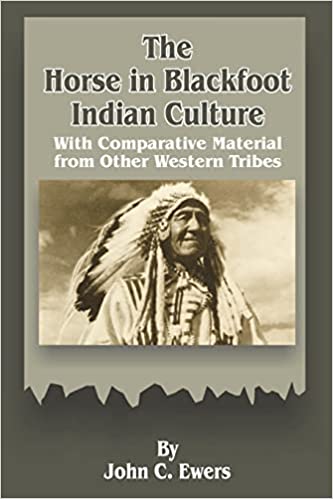
The Horse in Blackfoot Indian Culture: With Comparative Material from Other Western Tribes Paperback – July 1, 2001 by John C. Ewers - gently used
The Horse in Blackfoot Indian Culture: With Comparative Material from Other Western Tribes Paperback – July 1, 2001 by John C. Ewers - gently used
Clark Wissler (1927, p. 154) has named the period 1540 to 1880 in the history of the Indian tribes of the Great Plains "the horse culture period." This period can be defined more accurately and meaningfully in cultural than in temporal terms. Among all the tribes of the area it began much later than 1540. With some tribes it ended before 1880. Yet for each Plains Indian tribe the horse culture period spanned the years between the acquisition and first use of horses and the extermination of the economically important buffalo in the region in which that tribe lived.
Anthropologists and historians have been intrigued by the problem of the diffusion of the European horse among the Plains Indians. It is well known that many tribes began to acquire horses before their first recorded contacts with white men. Paucity of documentation has given rise to much speculation as to the sources of the horses diffused to these tribes, the date when the first Plains Indians acquired horses, the rate of diffusion from tribe to tribe, and the conditions under which the spread took place.
The three Blackfoot tribes of the northwestern Plains, the Piegan, Blood, and North Blackfoot, were among those tribes that possessed horses when first met by literate white men. To view their acquisition in proper historical and cultural perspective it is necessary to consider the larger problem of the diffusion of horses to the northern Plains and Plateau tribes.
Original: $55.00
-65%$55.00
$19.25The Horse in Blackfoot Indian Culture: With Comparative Material from Other Western Tribes Paperback – July 1, 2001 by John C. Ewers - gently used
Clark Wissler (1927, p. 154) has named the period 1540 to 1880 in the history of the Indian tribes of the Great Plains "the horse culture period." This period can be defined more accurately and meaningfully in cultural than in temporal terms. Among all the tribes of the area it began much later than 1540. With some tribes it ended before 1880. Yet for each Plains Indian tribe the horse culture period spanned the years between the acquisition and first use of horses and the extermination of the economically important buffalo in the region in which that tribe lived.
Anthropologists and historians have been intrigued by the problem of the diffusion of the European horse among the Plains Indians. It is well known that many tribes began to acquire horses before their first recorded contacts with white men. Paucity of documentation has given rise to much speculation as to the sources of the horses diffused to these tribes, the date when the first Plains Indians acquired horses, the rate of diffusion from tribe to tribe, and the conditions under which the spread took place.
The three Blackfoot tribes of the northwestern Plains, the Piegan, Blood, and North Blackfoot, were among those tribes that possessed horses when first met by literate white men. To view their acquisition in proper historical and cultural perspective it is necessary to consider the larger problem of the diffusion of horses to the northern Plains and Plateau tribes.
Product Information
Product Information
Shipping & Returns
Shipping & Returns
Description
Clark Wissler (1927, p. 154) has named the period 1540 to 1880 in the history of the Indian tribes of the Great Plains "the horse culture period." This period can be defined more accurately and meaningfully in cultural than in temporal terms. Among all the tribes of the area it began much later than 1540. With some tribes it ended before 1880. Yet for each Plains Indian tribe the horse culture period spanned the years between the acquisition and first use of horses and the extermination of the economically important buffalo in the region in which that tribe lived.
Anthropologists and historians have been intrigued by the problem of the diffusion of the European horse among the Plains Indians. It is well known that many tribes began to acquire horses before their first recorded contacts with white men. Paucity of documentation has given rise to much speculation as to the sources of the horses diffused to these tribes, the date when the first Plains Indians acquired horses, the rate of diffusion from tribe to tribe, and the conditions under which the spread took place.
The three Blackfoot tribes of the northwestern Plains, the Piegan, Blood, and North Blackfoot, were among those tribes that possessed horses when first met by literate white men. To view their acquisition in proper historical and cultural perspective it is necessary to consider the larger problem of the diffusion of horses to the northern Plains and Plateau tribes.